













Consolidate Difference Language Versions into Single Document
Hi
 Melissa
I was discussing an issue with my content team this morning, and it made me realize that we should reassess how we are presenting documents to users through the subscriber side of ISLG. Currently, when there is a document in different languages, we present each language version of the document as a separate document: https://www.investorstatelawguide.com/Treaties/Index?toc=mainAnnot&cat=&tab=#
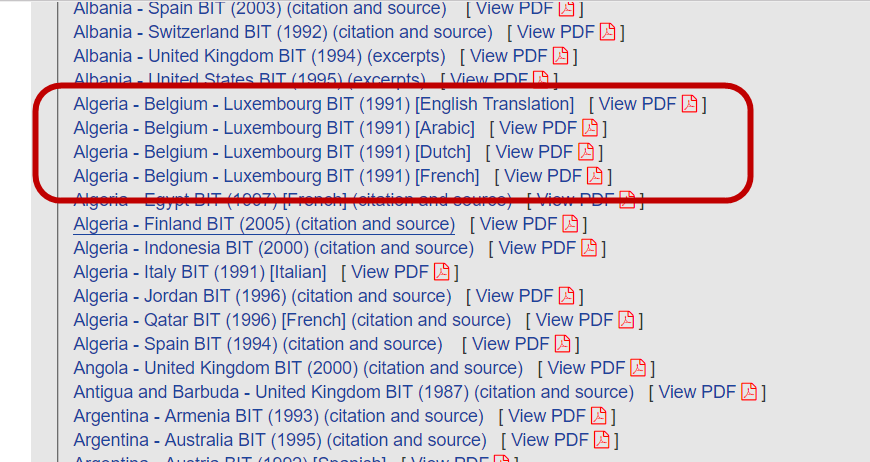
This was necessitated by the design of the existing ISLG application, which only allows presenting a single version of a document. However, I'm wondering if we should change this, and make it so that only a document can be presented in different language versions.
Do you see reasonably straightforward way for us to resolve this problem in the design of the new application? Note that this problem will exist for Treaties, Arbitration Rules and Dispute Documents.
Note that I'll add this to the agenda for discussion on Thursday.
Thanks,
Morgan
Melissa
I was discussing an issue with my content team this morning, and it made me realize that we should reassess how we are presenting documents to users through the subscriber side of ISLG. Currently, when there is a document in different languages, we present each language version of the document as a separate document: https://www.investorstatelawguide.com/Treaties/Index?toc=mainAnnot&cat=&tab=#
This was necessitated by the design of the existing ISLG application, which only allows presenting a single version of a document. However, I'm wondering if we should change this, and make it so that only a document can be presented in different language versions.
Do you see reasonably straightforward way for us to resolve this problem in the design of the new application? Note that this problem will exist for Treaties, Arbitration Rules and Dispute Documents.
Note that I'll add this to the agenda for discussion on Thursday.
Thanks,
Morgan
Following up on what we discussed this morning, I discussed the issue with
In the list under the BIT and Treaties tab, you'll see that I've added columns G (Associated Version(s)) and H (Primary):
Associated Version(s) will map which documents are associated with each other, and Primary will determine which document is the primary version for reference within the Article Citator and other master lists.
Note that I mention "reference within ... other master lists" because we also want to use this a parameter for limiting certain dropdown menus options that are pulling entries from the Treaties master list within the new application. For example, within Disputes, there is dropdown menu for Applicable Treaty, which pulls entries from the Treaties master list:
However, to avoid confusion for the admin users, we want to limit the options only to the primary version of the document, which will avoid disputes from being associated with different version of the same document. Therefore, we'll need to make updates to the applicable requirements within TargetProcess where this issue will arise.
Let me know if you have any questions. Happy to have a call to discuss.
Thanks,
Morgan
Can you please review the following cards re: the multiple language requirement:
Upload: 12640 https://industrialagency.tpondemand.com/entity/12640-dispute-document-greater-multiple-languages-greater
Document Groups: 12667 https://industrialagency.tpondemand.com/entity/12667-dispute-documents-greater-document-groups
Document groups > Mark as primary: 12687 https://industrialagency.tpondemand.com/entity/12687-dispute-documents-greater-document-groups-greater
Document Groups > Remove from group: 12689
https://industrialagency.tpondemand.com/entity/12689-dispute-documents-greater-document-groups-greater
Document groups > Add to group: 12690
https://industrialagency.tpondemand.com/entity/12690-dispute-documents-greater-document-groups-greater
Let us know if this approach is more in line with your thinking.
Mel
Morgan
The overall approach looks great. As you'll see in the comments, the only issue I identified was how to deal with existing analysis when changing the primary document. Perhaps we could create a mechanism where the analysis automatically transfers from one document to another, and then it would be up to the admin user to review, and ensure the transfer was successful (e.g., extracts are aligned with appropriate paragraph, etc.).
If technical constraints prevent us from doing this, at the very least, we should double check that there is a method for the admin user to download the data associated with the analysis from the previous primary version, and use this to analyze the new primary version.
Thanks,
Morgan
After talking things through with
In addition, I just realized that the user stories above focus on Dispute Documents, which we initially excluded from these requirements, but again, after further discussion with
Thanks,
Morgan
Sounds good. Based on your feedback I can build out the requirements for Treaties and Arbitration Rules.
For dispute documents we have requirements for "Analysis list' described here:
https://industrialagency.tpondemand.com/entity/9956-dispute-document-greater-analysis-list
This does not include the ability to download, however, we feel should be adequate for these dispute document cases.
For Treaties and Arbitration Rules, no analysis is actually completed on the document itself so this concept does not exist.
However, can we assume that Treaty/Rule documents will follow an identical structure across all languages (para 2.1 in English = para 2.1 in German)? If this is the case, we can design the feature to copy the references over to the new document.
Mel
Right, that "Analysis list" is what I was thinking. This should do. I also I assume that even if a document isn't the primary, an admin user will be able to view and edits any analysis performed on the document? That way a user could review the analysis in one window, and then copy the analysis in the new primary document?
Yes, the provision structure for Treaties and Arbitration Rules between different languages should be exactly the same. Having said that, as I mentioned above, it sounds like a transfer like this will be rare, and doing it manually should suffice when it occurs.
Morgan
Manually copying the references would mean going into each dispute document that refers to the treaty/rule and updating the reference. Does that seem manageable?
Mel
To be clear, analysis is not performed on Treaty/Rule documents, but multiple dispute documents may reference a treaty/rule. That means, when swapping a primary treaty/rule document those references need to be updated to point to the new treaty/rule document.
If you wanted to do this manually, you'd have to go into each separate dispute document and each reference to update the treaty/rule document that is being referenced.
Mel
Morgan
Mel